Bubur Panagah
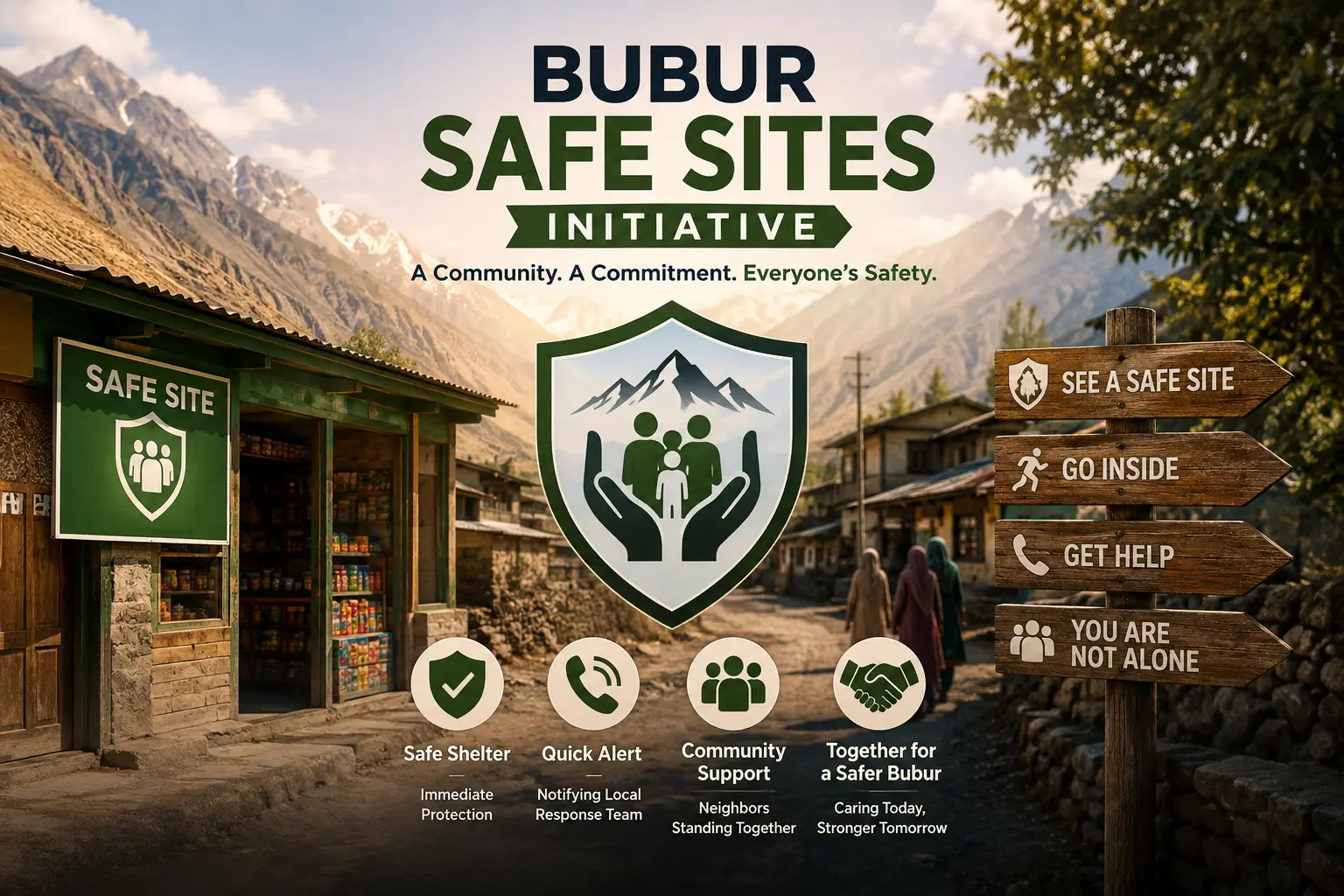
Bubur Safe Sites Initiative
Bubur is a village nestled in the northern areas of Gilgit-Baltistan, a region known for its breathtaking landscapes, close-knit communities, and a deep-rooted culture of collective responsibility. Yet, like many remote areas across Gilgit-Baltistan, Bubur falls within a constitutionally deprived region — an area where residents do not enjoy full constitutional representation, and where access to formal state services, including emergency response and law enforcement infrastructure, remains limited and often slow to reach those who need it most.
It is within this context that the Bubur Safe Sites Initiative has been introduced — a simple, low-tech, but deeply meaningful community protection network designed to ensure that no villager, regardless of age or gender, ever has to face a moment of danger or distress alone.
Why Bubur
Needed This
An emergency rarely announces itself in advance. It can arrive as a sudden fall on an icy path, a fire that spreads faster than help can reach, a traveler lost after dark, a family in medical distress, or someone being followed and afraid to walk further alone. In a city, such moments are often met within minutes — a nearby patrol, a quick call to emergency services, a crowd that steps in without hesitation. In a village like Bubur, tucked away in the mountains of Gilgit-Baltistan, that same reassurance cannot always be taken for granted. Mobile signal comes and goes, the nearest response post can be hours away, and in the space between an emergency unfolding and help arriving, a great deal can happen.
It is in that space — the gap between crisis and response — that the Safe Sites Initiative was born. Rather than wait for infrastructure that may take years to arrive, Bubur chose to build something immediate, using what it already had in abundance: neighbors who know each other, shops that never truly close their doors to those in need, and a community accustomed to looking after its own.
How the Initiative
Works
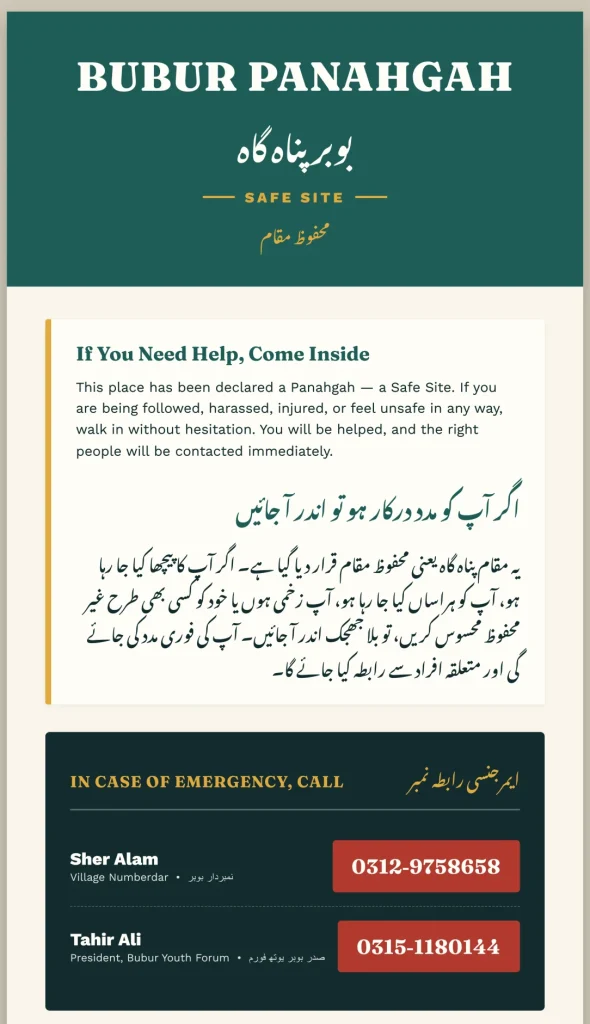
At the heart of this initiative are the village’s own shops — familiar, everyday spaces that villagers pass by constantly, whether on their way to school, to the fields, or simply through the village center. A number of these shops have been formally designated as Safe Sites, identifiable by a visible marker so that anyone in need can recognize them instantly.
If a villager — an elder, a woman, a girl, a boy, or anyone else — finds themselves being followed, harassed, injured, or simply feeling unsafe, they can walk directly into the nearest Safe Site shop. Once there, several things happen in quick succession:
- Immediate shelter and reassurance. The shop owner provides a safe space for the individual, away from whatever situation they were facing outside.
- Reporting to the appropriate response contacts. The shop owner alerts a designated set of local contacts who are responsible for responding to such situations.
- Follow-up and resolution. The situation is handled appropriately — whether that means ensuring the person gets home safely, involving family members, or escalating to relevant authorities in more serious cases.
This entire process is designed to happen quickly, without requiring the person in distress to explain themselves at length, make phone calls, or navigate any bureaucratic steps. In a moment of fear or panic, simplicity is what saves time — and sometimes, what saves lives.
Why a Shop-Based
Model Makes Sense
The choice to use shops as Safe Sites is deliberate. Shops in Bubur are open through most of the day, are spread across different parts of the village, and are run by individuals the community already knows and trusts. Unlike a dedicated safety office or hotline — which would require awareness campaigns, new infrastructure, and consistent staffing — shops are already woven into the daily rhythm of village life. This makes them a natural, low-cost, and highly accessible first point of contact during an emergency.
It also means the initiative did not require new buildings, new technology, or significant funding to get started. It required only cooperation, a clear protocol, and willing shop owners ready to take on a small but meaningful responsibility toward their neighbors.
A Reflection of Bubur’s
Culture of Community Governance
Bubur has long been recognized for the strength of its community governance — a place where local problem-solving and collective decision-making play a central role in daily life, even in the absence of full constitutional standing or robust government services. The Safe Sites Initiative is a natural extension of this culture. It demonstrates that meaningful protection systems do not always need to originate from state institutions; they can just as effectively be built from the ground up, by a community that understands its own needs better than anyone else.
This initiative is also a quiet but clear message to policymakers and government institutions: the people of Bubur are not waiting passively for services to arrive. They are actively building solutions, using what they have, while continuing to advocate for the formal recognition, resources, and constitutional rights that the region deserves.
Looking Ahead
The Safe Sites Initiative is an evolving effort. Over time, plans include expanding the number of designated shops to ensure wider coverage across the village, formalizing a clear response protocol for shop owners, and maintaining a private log of incidents to better understand recurring safety concerns in the area. This data can, in turn, support future conversations with local and regional authorities about extending formal protection services to Bubur and other underserved villages like it. At its core, this initiative is about one simple idea: that safety should not depend on how remote a village is, or how far it sits from the nearest police station. It should depend on the willingness of a community to look out for one another — and in Bubur, that willingness has always been present.