Wayaai Goonay: Bubur’s Community-Based Water Distribution System
Wayaai Goonay
Bubur’s Community-Based
Water Distribution System
Bubur is a village in Puniyal, a tehsil in Ghizer district, Gilgit-Baltistan. It is the second largest village in the tehsil by population. Like most villages in this mountainous region, Bubur depends on glacier melt for drinking water, cooking, and farming. This water has shaped daily life here for a long time — sometimes as a source of life, and in August 2022, as a flash flood that killed ten people in the village. But almost a hundred years before that flood, Bubur faced a very different water problem: not too much water, but not enough.
What the village did about that shortage is worth understanding closely. It’s not a story about a government office solving a technical problem. It’s a story about ordinary people — farmers, herders, elders — sitting down together and designing a system to share a limited resource fairly. That system is called Wayaai Goonay, and it is still running today, nearly ninety years after it was first put in place. This piece walks through how the crisis happened, how the village responded, how the system actually works day to day, and why it has managed to survive for as long as it has.
The Setting: A Village
Built Around Its Water
To understand why water mattered so much in Bubur, it helps to understand how the village is laid out. Bubur sits in a mountainous stretch of Ghizer district, and like the rest of this region, it has no rivers or reliable rainfall to depend on for irrigation. Its water comes from glacier melt, which flows down from higher elevations and collects at a point in the village known as the catchment section. From there, a channel network — built by the villagers themselves, not by any outside agency — carries the water outward, branching off again and again until it reaches every part of the settlement.

This matters because it means water in Bubur has never been something that simply “arrives.” It has always required infrastructure, labor, and coordination to move it from the glacier to the fields. Long before the water shortage that led to Wayaai Goonay, the village had already built the channels that made irrigation possible at all. What changed, over time, was not the infrastructure — it was the number of people and fields that infrastructure had to serve.
How the Problem
Started
Around ninety to a hundred years ago, Bubur had plenty of water. Glacier melt flowed generously into the catchment area, and there was enough for people to irrigate their fields freely, whenever they needed to, without much thought given to sharing or scheduling. Water was also plentiful enough for drinking and cooking without any competition over it.
That changed gradually, as it tends to in growing villages. The population increased. Families expanded, new houses were built, and land that had once been left barren was cleared and turned into farmland. All of this meant more people depending on the same source of water — but the water itself hadn’t grown to match. The glacier melt reaching the village was the same as before; it simply now had far more demand placed on it.
The effects were not small. Neighbors began arguing, and in some cases fighting, over irrigation turns — over who had the right to water their fields first, and for how long. Wheat and maize yields, the staple crops of the village, dropped as fields went without adequate water at critical points in the growing season. Grasslands set aside for grazing dried out, and the livestock that depended on them — cows, oxen, goats, sheep, donkeys, and horses — suffered along with the people. Fruit production declined too, and in Bubur, fruit was never a minor concern. Apricots, grapes, pomegranates, walnuts, figs, cherries, apples, and mulberries were a major part of both the local diet and the local economy, traded and relied upon much the way cash crops are today.
It’s worth being clear about what this period represented. This wasn’t a case of an existing system breaking down. There was no formal system yet — no schedule, no shared understanding of whose turn it was to draw water and when. What existed was simply first-come, first-served, and as demand grew past what the water could support, that approach stopped working. The result was scarcity, and the conflict that scarcity produced.
How the Village
Responded
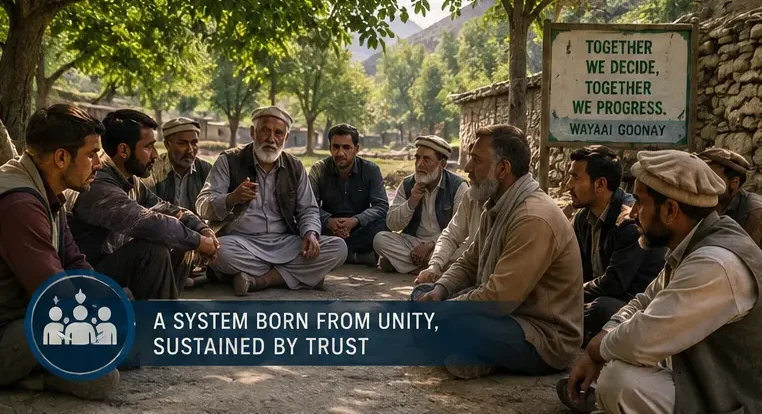
This is the part of Bubur’s history that deserves the most attention, because of how directly the community dealt with it. Rather than letting the conflict continue or waiting for it to resolve on its own, the Lumberdar — the village head — called a public gathering. The purpose was straightforward: bring everyone together and work out a way to share the water so that no one went without, and so that the fighting would stop.
Out of that gathering came a time-based, rotational water distribution system. The village calls it Wayaai Goonay, and the basic idea behind it is simple to state, even if putting it into practice took real coordination: instead of everyone drawing water whenever they wanted, each part of the community would get a dedicated window of time to use the water, one after another, in a fixed order that everyone agreed to and everyone could see.
To understand how this system was structured, it helps to understand who it needed to work for. Bubur’s population isn’t organized as dozens of small, separate households competing individually. It’s organized into five large clans — Munay, Muaay, Sharmatay, Majo, and Fatinaay. These are substantial groups, each including well over a hundred people, with members living across different parts of the village rather than in one concentrated area. Any water-sharing system in Bubur had to work at the scale of these five clans, not at the scale of individual families.
Managing something this size fairly wasn’t something the Lumberdar could reasonably do alone, and the village didn’t ask him to. Alongside the Lumberdar, two representatives from each of the five clans were elected every year to a supervisory body called the Zaitun. Ten people in total, plus the Lumberdar, serving for a full year at a time before the next round of representatives took over. This gave every clan a direct voice in how the system was run, not just in how it was designed at the start.
What stands out most, looking back at how this all came together, is that none of it was imposed from outside. It wasn’t a rule handed down by an authority the village had no part in choosing. It was built through direct agreement — the Lumberdar called the gathering, but the terms of Wayaai Goonay came out of collective discussion and consent among the people it would govern. That detail is easy to skim past, but it’s probably the single biggest reason the system has lasted as long as it has. People are far more likely to follow a rule they helped create than one that was simply given to them.
How the System
Actually Works
Wayaai Goonay isn’t something that runs constantly in the background. It follows the rhythm of the farming calendar, activating each year around the time crops need watering.
The process starts before any water is distributed at all. When the Lumberdar determines that the watering season is approaching, the first step is preparation, not distribution. Every clan is called on to clean the village’s water channels — clearing out silt, debris, and anything else that could cause leaks or blockages along the route from the catchment section to the fields. This is shared labor, done by all five clans together, and it’s typically finished within about a week. Once the cleaning is done, the Zaitun physically walks the length of the channel network to inspect it and confirm it’s actually ready. Distribution doesn’t begin until that inspection is complete.
Once the channels are confirmed ready, the rotation order is set. This happens in public, in front of the whole village. The Lumberdar writes the names of the five clans on small folded slips of paper and draws them out one at a time from a traditional cap, in full view of everyone present. This open, visible process is how the order of turns gets decided — no clan chooses its own position, and no one can claim afterward that the order was decided unfairly, because everyone watched it happen.
Whichever clan’s name is drawn first receives the first turn: a set block of time during which that clan, and only that clan, waters its fields and grazing land. Once that window closes, the next clan in the drawn order takes its turn, and so on until all five clans have had their allotted time. During any clan’s turn, the other four are expected to wait — no one else draws water until their own turn comes around, regardless of how urgently they might need it.
This is not simply an honor system left to trust alone. The Lumberdar and the Zaitun actively walk the channels throughout the rotation period to confirm that each clan’s turn is being respected. If someone is found taking water outside their allotted time, they face a fine, paid directly to the clan whose turn was affected. That fine can take different forms — cash, a sack of wheat or maize, or livestock — but the key detail is who it’s paid to. It doesn’t go to the Lumberdar or into some general fund; it goes to the people who were directly wronged by the violation. That keeps the consequence personal and immediate, rather than abstract.
And critically — no clan’s wealth, the size of its landholding, or its general standing in the village changes where it falls in the rotation. A clan with more land or more influence gets exactly the same treatment as any other. The draw decides the order, and that’s the end of the discussion.
Why the System
Has Lasted
What makes Wayaai Goonay genuinely notable isn’t just that it was a good idea when it was introduced. It’s that it has held, essentially unchanged in its core structure, for close to a century — without needing to be re-imposed, renegotiated, or enforced by any outside authority.
By every account gathered from people in the village, this isn’t because anyone is afraid to break it. It’s because almost no one tries to. And the explanation people give for that is consistent: the system was built by the community’s own request and agreement, not forced on them from above. That distinction matters more than it might seem to at first. A rule that people design together, and that treats everyone the same regardless of status, tends to earn a kind of buy-in that a rule simply handed down from an outside authority rarely does. People follow it not because they’re being watched, but because they see it as theirs.
The practical outcomes support this. Since Wayaai Goonay took hold, the open conflict that once defined the growing season in Bubur largely disappeared. Every clan gets its turn to water its land, regardless of how much land it has or how good that land is. The fine system converts a violation into a direct, immediate cost paid to the people affected by it, which keeps enforcement local and personal rather than bureaucratic. And over time, the results showed up in the fields themselves — crop yields recovered, livestock stopped suffering from a lack of water for grazing land, and the fruit orchards that had thinned out during the crisis years came back as a real source of both food and income for households across the village.
What This
Offers Others
Wayaai Goonay isn’t a piece of village folklore or a story about how things used to be done. It’s a system that is still running today, still managing something as essential as water, still maintained by the same clans and the same kind of yearly process that put it in place nearly ninety years ago.
What it demonstrates is worth sitting with: a community facing a real crisis — one that was already producing conflict and hardship — was able to design its own solution, one that has proven durable enough to outlast nearly a century of change around it. It shows what’s possible when people are trusted to work out a fair way to share something they all depend on: a process that’s transparent enough for everyone to witness, fair enough that wealth and status don’t change the outcome, and accepted enough that it doesn’t need to be constantly re-enforced from outside.
This kind of local knowledge has real value beyond Bubur itself — for anyone thinking about water-sharing systems, community dispute resolution, or local governance more broadly, including government institutions looking for models that have already proven themselves over time. Wayaai Goonay has been running in Bubur for close to a century, quietly and consistently, and it’s still working today.